The Rise of AI-Native Agencies: From Products to Outcomes in 2026
Written By
Hassan Baig
CTO SprintX
February 05, 2026
20 min read
How AI is transforming the fundamental economics of service businesses—and why outcomes are becoming more valuable than software products
Introduction
Two years ago, the narrative was clear: AI would kill consulting. Software would eat the world, and service businesses would become obsolete. Yet here we are in 2026, and something unexpected is happening. A new breed of service company—call them AI-native agencies—appears to be thriving while traditional SaaS faces unprecedented competition.
We're seeing this shift firsthand. While SaaS markets fragment under the weight of infinite indie competitors and commoditization, service businesses with AI-first delivery models are emerging with economics that would have seemed impossible 24 months ago.
This isn't about agencies versus SaaS—both models will continue to coexist. It's about a growing shift from selling products to delivering outcomes, and the economic dynamics that make this increasingly attractive for certain types of work. In this analysis, we'll examine the unit economics, look at companies reportedly scaling faster than traditional SaaS benchmarks, and explore why AI-talent may be emerging as a key constraint.
What is an AI-Native Agency?
An AI-native agency is a service business built from the ground up to leverage AI for delivery, targeting software-like margins (70-90%) and scale while maintaining an outcome-focused service model. Unlike traditional agencies that bolt AI onto existing processes, these companies architect their entire delivery around AI capabilities.
Key characteristics:
- AI-first delivery: Core workflows designed around AI automation, not human-centric processes with AI "assistance"
- Outcome pricing: Charging for results delivered (meetings booked, tickets resolved, revenue generated) rather than hours or seat licenses
- Lean teams: Small groups of AI-fluent experts who architect, deploy, and optimize AI systems rather than large execution-focused staff
The critical difference isn't just using AI tools—it's building the entire business model around AI's ability to compress delivery costs while maintaining service quality. A traditional agency might use ChatGPT to write faster. An AI-native agency builds proprietary AI workflows that let one expert deliver what previously required a larger team.
Important caveat: "AI-native agency" is an umbrella term covering several distinct business models. Harvey operates high-touch enterprise legal services. Mercor runs a marketplace connecting AI talent to labs. 11x sells "digital workers" that blur the line between service and software. Copy.ai combines product-led growth with professional services. These share DNA but face different economics, constraints, and competitive dynamics. The patterns in this analysis apply most directly to pure-service models, though lessons translate across variations.
The Shift Everyone Missed: Agencies Are Thriving, Not Dying
The conventional wisdom sounded reasonable: as AI gets better at specialized tasks, companies would buy software instead of hiring consultants. Agencies would struggle. The future belonged to productized AI.
Something different appears to be happening.
While analysts debated the death of consulting, AI-native service companies started closing deals traditional SaaS struggled to win. Companies are choosing service partners over software products—not because of technology limitations, but because of what businesses actually want to buy.
What the reported numbers suggest:
- Sierra reportedly reached $100M ARR in 21 months (per company announcements and TechCrunch)
- Harvey expanded from 40 customers to 1,000+ across 60 countries, according to investor disclosures
- Mercor's reported run rate grew from ~$75M to ~$840M in 8 months (per Sacra estimates, based on investor communications)
- Copy.ai reported 480% revenue growth in 2024
A note on these figures: run rates and ARR numbers for private companies often come from investor presentations or press releases, not audited financials. The trajectory is directionally interesting, but specific numbers should be read as reported estimates, not verified facts.
What's harder to dispute: Y Combinator's Spring 2025 batch consisted of 46% AI agent companies—startups that sell work, not software. The batch before that saw more than half of companies building or using AI technology. The investor thesis here is clear, even if individual company metrics remain fuzzy.
What seems to be changing:
Customers increasingly want outcomes without owning infrastructure. A VP of Sales doesn't want to configure an AI SDR platform—they want meetings booked. A General Counsel doesn't want to manage legal AI—they want research completed and contracts reviewed.
The shift from products to outcomes opened a door that traditional SaaS struggled to walk through. Products require customer success teams, implementation consultants, and ongoing support. Outcomes require expertise, accountability, and results. AI appears to be making it economically viable to deliver the latter at something closer to the scale of the former.
Here's the emerging pattern: AI didn't make services obsolete. It may be making service delivery more scalable.
The Changing SaaS Landscape
To understand why service models are gaining traction, it helps to understand what's happening to SaaS.
SaaS isn't dying—it's fragmenting. The barrier to building software has collapsed. What used to take a team of engineers six months now takes one developer with Cursor or Lovable a weekend. Both reportedly hit $100M ARR in their first year. Cursor reached $200M in revenue before hiring a single enterprise sales rep, according to company sources.
The result: intensifying competition and commoditization pressure.
Remember when there were five project management tools? Now there are hundreds. The same pattern repeats across categories. AI coding tools accelerated an indie SaaS explosion that changed market dynamics:
- Building software is dramatically faster and cheaper than in 2023
- Time-to-market compressed from months to days
- Distribution still matters, but product differentiation is harder to sustain
- Features get copied quickly
- Pricing pressure is constant as competitors undercut each other
The companies building pickaxes for this gold rush—Cursor, Lovable, v0, Bolt—appear to be scaling faster than many of the products built with them.
What this suggests for SaaS:
Traditional SaaS companies face more competition than ever, from established players and indie builders alike. Big SaaS isn't dead, but mid-market SaaS is getting squeezed between enterprise giants and low-cost upstarts. When everyone can build the product, the product stops being the primary differentiator.
This is where service businesses may have found an opening.
While SaaS companies compete on features and pricing, AI-native agencies compete on outcomes. They don't sell the SDR software—they book meetings. They don't license the customer service platform—they resolve tickets.
SaaS fragmentation may be creating a counter-trend: the rise of outcome-focused services that abstract away tooling complexity. Customers don't want to evaluate thirty AI SDR platforms. They want their pipeline filled.
The emerging dynamic: more competition in SaaS may mean less competition for AI-native agencies. While thousands of founders build competing tools, fewer have the AI talent and domain expertise to deliver reliable results at scale. The constraint shifts from "who can build the software" to "who can deploy it effectively."
That's a service business game.
How AI-Native Agencies Achieve Service Economics at Software Scale
For decades, service businesses faced a trade-off: high margins or high scale, pick one. Consulting firms had healthy margins but needed to hire linearly with revenue. SaaS had scale but required massive upfront investment.
AI-native agencies appear to be finding a third path.
The economics shift:
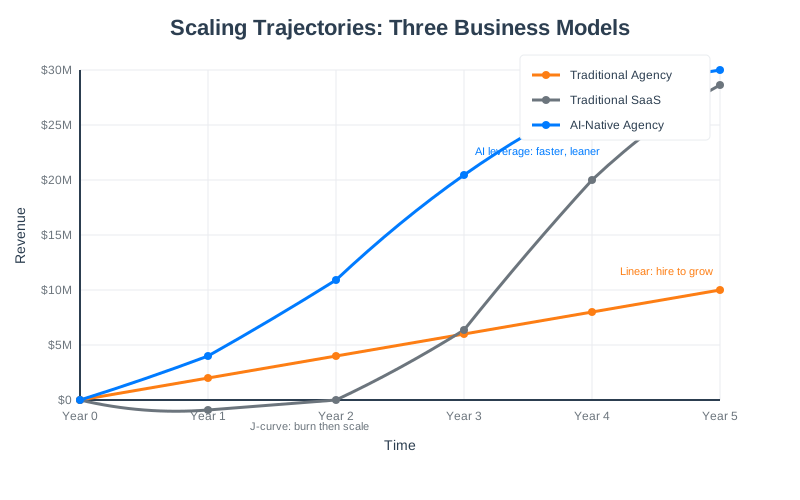
Traditional agencies operate on human leverage. Revenue scales with headcount. Margins stay healthy (40-60%) but growth requires constant hiring.
Traditional SaaS operates on software leverage. Build once, sell infinitely. But the "build once" part costs millions, and customer acquisition burns cash for years.
AI-native agencies operate on AI leverage. Small teams build proprietary AI workflows that multiply their output. They sell outcomes at service-level pricing, but deliver through automation, so costs can scale sublinearly with revenue.
The model's advantages (in theory and emerging practice):
- Service-level pricing: Charge based on value delivered rather than seat licenses
- Lower delivery costs: AI handles execution, humans handle strategy and oversight
- Faster deployment: Outcomes can flow in weeks, not months
- Compounding systems: Client engagements can improve the AI workflows over time
Automation without full productization:
Here's what separates this from just building SaaS: AI-native agencies often stop short of full productization. They maintain the service wrapper because that's where the value is.
A fully productized AI SDR platform has to work for everyone. It needs onboarding flows, configuration options, integrations, support documentation, and customer success. Customers expect to operate it themselves.
An AI SDR service just needs to work for this customer, right now. The team can use custom prompts, proprietary data connections, and manual oversight for edge cases. The customer just sees results.
The service model lets you deliver AI capabilities before they're ready for productization. In many cases, they shouldn't be productized—the value is in expert judgment combined with AI execution.
Talent leverage:
The traditional consulting model required deep benches of junior talent. AI changes this. You want a small number of highly-skilled people who can build, deploy, and optimize AI systems. One AI-fluent expert may create more value than a larger team of traditional consultants.
This creates a different scaling curve. Traditional agencies hire ahead of revenue. AI-native agencies can take on more work before needing another hire, and when they do hire, they're looking for senior talent who can extend AI capabilities—not junior execution capacity.
Unit Economics: Agencies vs SaaS in 2026
Let's look at the numbers. These are composite estimates based on reported figures from company announcements, investor presentations, and industry benchmarks. Specific company metrics should be treated as reported claims, not audited data.
Traditional SaaS Economics (Well-established benchmarks)
Revenue Metrics:
- Time to $30M ARR: 60+ months (median, per OpenView/Bessemer data)
- Revenue per employee: $400K-$600K
- Typical team size at $30M ARR: 50-75 employees
Cost Structure:
- Gross margin: 70-85% (at scale)
- R&D: 25-40% of revenue
- Sales & Marketing: 40-60% of revenue
Customer Acquisition:
- CAC payback period: 12-18 months
- Enterprise sales cycles: 6-12 months
AI-Native Agency Economics (Emerging estimates)
Revenue Metrics:
- Time to $30M ARR: Reportedly 20-30 months for top performers (limited sample size)
- Revenue per employee: Estimates range from $1M-$3M+ for lean teams
- Typical team size at $30M: 10-30 employees
Cost Structure:
- Gross margin: 60-90% (wide range depending on delivery model)
- Delivery (AI + human oversight): 10-40% of revenue
- Sales & Marketing: 15-30% of revenue
Customer Acquisition:
- Time to value: Days to weeks
- Sales cycles: 2-8 weeks typical
Caveat: AI-native agency data comes from a small set of companies, mostly pre-IPO with unaudited financials. These figures represent what leading companies report, not industry medians.
Side-by-Side Comparison
| Metric | Traditional SaaS | AI-Native Agency (Reported) | Traditional Agency |
|---|---|---|---|
| Time to $30M ARR | 60+ months | 20-30 months* | 60-120 months |
| Revenue/Employee | $400K-$600K | $1M-$3M+* | $150K-$250K |
| Gross Margin | 70-85% | 60-90% | 40-60% |
| Team at $30M | 50-75 | 10-30* | 120-200 |
*Based on reported figures from a small sample of high-performing companies
Key Patterns
1. Faster scaling appears possible Top AI-native agencies reportedly reach revenue milestones faster than traditional SaaS. How much faster, and whether this persists at scale, remains to be seen.
2. Capital efficiency looks better Smaller teams and lower upfront investment mean AI-native agencies can potentially reach profitability faster with less capital.
3. Margins can rival software For delivery models that successfully automate execution, margins approach software levels while maintaining service pricing.
4. Customer acquisition compresses Selling outcomes instead of software can shorten sales cycles. Customers see value quickly because the agency handles deployment.
Important context: These economics look compelling for companies that execute well in domains where outcome pricing works. Not every vertical supports this model—more on that below.
Common Mistakes When Building an AI-Native Agency
The economics look compelling on paper. So why isn't everyone building AI-native agencies?
Because the model is unforgiving. Here's what we've observed and what tends to kill most attempts:
1. Over-productizing Too Early
The mistake: Teams see AI automation working and immediately think, "Let's turn this into SaaS." They start building configuration UIs, onboarding flows, and self-service features.
Why it fails: You abandon your competitive advantage. The value isn't the AI itself—it's your expertise in deploying it for specific outcomes. The moment you productize, you're competing with every SaaS company building similar tools.
What to do instead: Keep the service wrapper longer than feels necessary. Scale by improving AI workflows, not by building product features. Harvey didn't build self-service legal AI. They built AI that lawyers trust because Harvey's team handles complexity.
2. Ignoring Delivery Quality
The mistake: The AI produces "good enough" results, so teams ship without expert review. Volume goes up, quality goes down, clients churn.
Why it fails: You're selling outcomes, not software with known limitations. If the AI makes mistakes and you don't catch them, that's on you.
What to do instead: Build quality control into every workflow. The goal is expert-level work at AI speed, not AI-level work at maximum speed. In my experience, agencies that maintain rigorous QA scale sustainably; those that prioritize throughput over quality tend to struggle with retention.
3. Hiring Too Fast
The mistake: Revenue grows, so teams hire aggressively. They bring on staff before optimizing AI workflows.
Why it fails: You rebuild the traditional agency headcount model. Every hire makes the business less efficient.
What to do instead: Stay uncomfortably lean. Optimize AI delivery before adding people. When you do hire, hire for AI fluency and domain expertise—people who extend capabilities, not execute repetitive tasks.
4. Competing on Price vs Outcomes
The mistake: Pricing based on cost (how cheap can AI make delivery?) rather than value (what outcomes are worth to customers).
Why it fails: Race to the bottom. AI democratizes delivery, which means cost-based pricing gets commoditized.
What to do instead: Price on outcomes delivered. What's a qualified sales meeting worth? Charge based on that value, regardless of whether AI made it cheaper to deliver. Intercom charges 99¢ per resolved support ticket—per resolution, not per AI interaction.
Important caveat on outcome pricing: This model works well for bounded, measurable outcomes—meetings booked, tickets resolved, documents reviewed. It's harder in complex enterprise transformations, regulatory-heavy contexts, or situations with multi-stakeholder outcomes. Know your domain's constraints before defaulting to outcome pricing.
5. Neglecting Expert Positioning
The mistake: Marketing as "AI-powered" instead of domain experts who leverage AI. The pitch becomes about technology, not expertise.
Why it fails: Customers don't buy AI. They buy outcomes from people they trust.
What to do instead: Build domain authority first. Your ideal customer should see you as the expert in their problem who happens to use AI for delivery efficiency—not an AI company that happens to work in their domain.
The pattern: abandoning what makes the model work in pursuit of what feels easier. The companies winning this market are doing the harder thing at every turn—maintaining standards while scaling with AI, building expertise moats rather than feature moats.
What This Means for Founders in 2026-2027
Here's what the emerging patterns suggest about where this is heading:
AI-Talent May Be the Key Constraint
Here's the dynamic worth paying attention to: SaaS has intensifying competition and abundant developer talent. AI-native agencies face growing competition but may face talent scarcity.
Thousands of developers can build SaaS products with Cursor and Lovable. Fewer can architect, deploy, and optimize AI systems that deliver reliable outcomes at scale. Domain expertise combined with AI fluency is uncommon.
This may create a moat. Traditional consulting could hire smart graduates and train them. Traditional SaaS could hire engineers and ship features. AI-native agencies need people who understand both the domain deeply and how to leverage AI effectively. That combination doesn't scale through job postings alone.
What this suggests for founders:
- Invest in AI upskilling for your team
- Build training systems that create AI-fluent experts internally
- Hire for AI aptitude and domain expertise over pure execution capacity
Worth pondering: Organizations with staff actively resisting AI adoption may find themselves at a compounding disadvantage. The gap between AI-fluent and AI-resistant teams appears to be widening.
Vertical Specialization Matters
The horizontal "AI consulting for everyone" positioning rarely wins deals or commands premium pricing.
Look at how the market is developing: Harvey focuses on legal. Sierra on customer service. 11x on sales development. These are deep specialists who understand workflow, metrics, buying process, and success criteria for specific functions.
What this suggests for founders:
- Pick one vertical and go deep
- Build case studies and ROI proof points specific to that market
- Develop proprietary workflows that improve with every engagement
- Establish thought leadership in that vertical, not "AI" broadly
The Productization Question
Eventually, some AI-native agencies will productize. The question is when and how.
Signals that productization might make sense:
- AI workflows are reliable enough to rarely need expert intervention
- Customers are asking for self-service options
- Well-funded SaaS companies are building competitive products
- You've reached limits of your addressable market at service pricing
Signals to stay in service mode:
- Expert oversight still catches meaningful errors
- Customers prefer outcomes over tools
- Your differentiation is domain expertise, not just AI automation
- The market is growing faster than you can capture
My current view: most AI-native agencies should stay in service mode longer than instinct suggests. The service premium is worth protecting.
Capital Markets
AI-native agencies are commanding high valuations—40-50x revenue multiples have been reported for high-growth AI companies. Sierra, Harvey, and Mercor have all reportedly raised at multi-billion dollar valuations.
But investors are also getting more selective. High multiples appear to go to companies with:
- Proprietary AI systems that improve with scale
- Strong retention metrics
- Clear paths to market dominance in their vertical
- Teams that can articulate their moat beyond "we use AI"
The "AI-powered consulting" pitch without differentiation is likely to struggle.
What to Build Now
If you're starting or scaling an AI-native agency:
1. Domain expertise first, AI second Build reputation as experts in a specific problem domain. Let AI be your delivery advantage, not your marketing message.
2. Proprietary workflows that compound Every engagement should improve your AI systems. Build feedback loops and quality metrics into delivery.
3. Outcome-based pricing (where it fits) Anchor pricing to customer value, not delivery costs—but know the limitations of outcome pricing in complex domains.
4. Quality obsession Build reputation on reliability. Expert-level work at AI speed, not AI-level work at maximum speed.
5. Lean, expert teams Stay uncomfortably small with AI-fluent experts who can extend capabilities.
The opportunity appears real. The economics can work. But it requires discipline, domain expertise, and willingness to do the harder thing at each decision point.
Conclusion
The conventional wisdom may have it backwards. AI doesn't appear to be killing service businesses—it may be making outcome-based services economically superior to products for certain types of work.
The early data is suggestive: AI-native companies report faster scaling, higher revenue per employee, and margins approaching software levels. They're raising capital at high valuations while maintaining service pricing. They're scaling expertise instead of headcount.
Whether this represents a durable shift or early-market enthusiasm remains to be seen. But the underlying logic is sound: SaaS fragmentation created competitive pressure. AI-native agencies responded by competing on results rather than features. Many customers prefer outcomes over infrastructure to manage.
Three patterns seem worth internalizing:
First: AI-talent, not market size, may be the key constraint. Building teams of AI-fluent domain experts is harder than raising capital or finding customers. Invest in talent development.
Second: Vertical specialization matters. The horizontal "AI consulting" play struggles to win deals or command pricing. Deep domain expertise combined with proprietary AI workflows can create defensible positions.
Third: Outcomes can command premium pricing—but know when this applies. Outcome pricing works for bounded, measurable deliverables. It's harder in complex enterprise transformations or multi-stakeholder contexts.
We're watching this unfold at SprintX. The shift from products to outcomes isn't purely theoretical—we're seeing it across verticals. The companies building now with discipline, quality focus, and expert positioning are well-placed to capture the opportunity.
The ones ignoring AI or chasing the wrong model may find themselves at a compounding disadvantage.
Want to follow our journey building in the AI-native agency space? Subscribe to our newsletter for insights, frameworks, and lessons learned scaling outcome-focused service businesses. We share what's working, what's not, and where this market is heading.
Sources & Methodology
Company-specific figures cited in this analysis come from:
- Press releases and company announcements (Sierra, Harvey, Mercor)
- Investor disclosures and presentations
- Industry research from Sacra, Menlo Ventures, and OpenView Partners
- TechCrunch, VentureBeat, and other tech journalism
- Y Combinator batch data and announcements
Important note: Most companies cited are private with unaudited financials. Revenue figures, run rates, and growth metrics represent what companies or investors have publicly claimed, not independently verified data. Treat specific numbers as directionally informative rather than precisely accurate.
Traditional SaaS benchmarks draw from established industry sources including OpenView's SaaS Benchmarks, Bessemer Venture Partners' State of Cloud, and KeyBanc's SaaS surveys.